There’s a stage of life where nothing is wrong, exactly—but something feels slightly out of alignment. The way we eat, the way our homes function, the way our days flow no longer match who we are now. This is a story from a moment like that, when I slowed down long enough to think out loud, reconsider what I already had, and gently reshape my space to support the life I’m actually living.
I wasn’t 100% gung ho about reorganizing the kitchen, and the thought of it kept me awake.
In the early hours of the morning, I talked though my kitchen with a digital assistant that helped me notice patterns – every cabinet and drawer, talking out what to keep, what to move, and how to shape my kitchen for the way I actually live now. I described where things were, what I used, what I didn’t, and what felt like friction every time I opened a door.
By the time we finished mapping it, I felt steadier—and finally ready to rest.
The Brunch Bowl That Fueled the Day
When I eventually made my way to the kitchen later that morning, it wasn’t really breakfast anymore. It was more like a calm, intentional brunch. I needed something that would carry me through the physical work ahead. My daughter was coming later to help me reorganize, and I wanted to feel grounded before the lifting, sorting, and decision-making began.
I told my AI what kind of day it was shaping up to be and what kind of energy it would require. It translated that into a recipe that was light, sustaining, and quietly satisfying. Nothing fancy. Just the right balance of fuel and comfort.
As I stirred the berries through the yogurt, I realized this is what it looks like when I use technology as a thinking partner.
It doesn’t tell me what to do. It listens. It interprets. It keeps track of my nutrition quietly in the background and helps me see the next right step—whether I’m planning meals, reorganizing my home, or building my small business.
By the time my daughter arrived, I wasn’t anxious anymore.
Mapping the Kitchen
I had a plan—not a rigid checklist, but a calm internal map of what mattered, what didn’t, and what could wait. The kitchen no longer felt like a puzzle with too many options. It felt like a space ready to be shaped.
We started where the friction lived.
Cabinets that once supported a life of entertaining—rows of wine glasses, cocktail tools, and party supplies—were gently reassigned. Not discarded in a rush, but re-zoned with respect. What I actually used every day moved into easy reach. What belonged to an earlier chapter found a quieter home or went into a donation box. A few beautiful pieces stayed, not because I might need them, but because I liked them.
Reassigning Space with Intention
One under-counter cabinet, in particular, changed purpose. It had been dedicated to wine and entertaining supplies—things that once made sense for a more social, hosting-oriented season of my life. But that setup no longer reflected how I live or use my kitchen now. Reclaiming that space for practical things—quietly shifted the feel of the entire kitchen. The room began to support my current needs instead of preserving an old setup.
When Space Reflects the Life You’re Living
That small change made me think about how easily we hold on to space for lives we’re no longer living. Not because we’re attached to the objects themselves, but because we’re keeping room for a version of ourselves we might return to someday—just in case. It’s the same impulse that keeps multiple sizes of clothes hanging in a closet, waiting for a future body or a past one. Over time, those “just in case” choices add up. They ask more from our homes, more from our energy, and sometimes more space than we truly need.
Even the countertops shifted—from surfaces that quietly accumulated clutter to defined stations that supported my rhythms. Coffee and tea where mornings begin. Appliances I actually use kept visible without apology. Prep space left intentionally open, not empty, but ready.
What Changed — and Why It Matters
Nothing dramatic happened.
No before-and-after shock photos.
No minimalist purge.
And yet—by the end of the process, the kitchen felt different.
Lighter.
Quieter.
More cooperative.
What surprised me most was how physical the relief was. My shoulders dropped. Decisions stopped stacking up in my head. I wasn’t managing my kitchen anymore—it was supporting me.
Organization isn’t about perfection. It’s about reducing resistance.
When your environment matches your real life—your appetite, your energy, your age, your values—everything takes less effort. Eating better feels easier. Cooking feels less taxing. Even rest comes more naturally.
A Different Kind of Intelligence
This is what working with AI looks like in my real life.
It isn’t about automation for its own sake.
It’s about having a steady partner who can hold the details while I listen to my body, my space, and my intuition.
Together, we didn’t just plan a kitchen.
We reclaimed a rhythm.
And that bowl of yogurt and berries?
It didn’t just fuel the work.
It marked the moment I stopped trying to live like a former self—and started living for my best self again.
THE BRUNCH BOWL THAT FUELED THE DAY
Simple, sustaining, and intentionally balanced
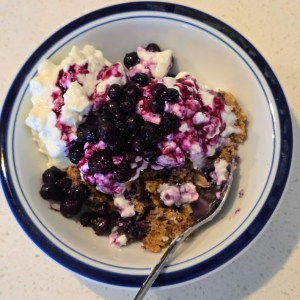
Cottage cheese (2%): 100 g
Fage 2% plain Greek yogurt: 80 g
Trader Joe’s Berry Cherry Blend (frozen): 56 g (weigh frozen; thaw slightly)
Chia seeds: 1 teaspoon
Crushed walnuts: 1 tablespoon (about 7 g)
Cinnamon and vanilla extract: to taste
Better yet: Build it in a clear glass or stemless wine glass to showcase the layers—a small luxury in the middle of a busy, physical day.
 My Ageless Best
Leave a comment